Tuesday, February 1, 2011

geography

sixth grade visits europe


The sixth graders of Davis Waldorf School (no, we really did not take a filed trip to Europe - but that would have been molto fantastico!) came back from their winter break to learn a little about geography. The three branches of geography are physical (biomes, cartography, coordinates), human (cultures, populations), and environmental (resource management).

We learned about the different biomes of the world (forest, grassland, tundra, desert, marine, and freshwater). The students created dioramas of their biomes, which we called "bioramas." They were spectacular! Some had fashioned trees from wire and frayed rope, animals from beeswax, snow from old cotton jerseys, and rocky cliffs from clay.

We learned about latitude and longitude, and how to make accurate maps using a grid technique.

To study human geography, the students are researching European countries for their reports. It is a big undertaking for the sixth graders as they are learning to choose the right resources and compile information about the land, the culture, and landmarks. They are writing creatively and using illustrations to create beautiful reports.

To bring in the global, environmental consciousness into our work, I had the students list their observations of things outside our classroom. It was not surprising that when I had them categorize their observations between human, human-made, and nature-made, most things they listed were human-made. I had told them that it was very important how our geography is closely tied to human impact, that it was our responsibility to always be mindful of how we interact with our earth.


Saturday, December 18, 2010

supply and demand

grade six economics and winter concert


Supply and demand is a relationship. It is about the dynamic balance of what we produce and what we want. During our three weeks of economics, sixth grade viewed the world in this way. The relationship begins with what the earth itself provides: natural elements that through human use become natural resources. From natural resources, we derive raw materials. Raw materials give us the stuff to be self-sustaining. When reliance for survival shifts outside of the self, we enter into barter. From barter develops a more convenient form of exchange, currency. In maintaining mutually beneficial exchange, we discussed value and worth. From understanding the value of things, the theory of economics itself is formed: production, distribution, and consumption of goods and services. Then the world of entrepreneurship, profit, capital, and interest opened up. From here, we were ready to tackle suppy and demand.

I had deliberately (strategically) placed our economics block just before our winter break. There was no better way for the students to understand economics than to experience it. We created Grade Six Greetings, converting our classroom into an assembly factory. We produced greeting cards with original artwork by the students, and sold them to the school community, just in time for the holidays! Consumers demanded, and we supplied. Lo and behold, we turned a profit!

In the midst of the excitement of our curriculum coming to life, we also had practiced for our school Winter Concert. I wrote an instrumental piece for the sixth grade strings ensemble called Winter Solstice, which our strings teacher arranged for me, and composed a song called Gift of Light, with choreography. At the Winter Concert, the sixth graders were magical, inspiring, and awesome. The audience demanded, and we supplied!

In each of these students, there is a light. It flickers, it dances, it glows, it warms, it shines. The light fills me with hope and encourages me to keep doing what I do. I nurture the light, cup it with a gentle hand when a mischievous wind comes blowing. I keep it safe, let it shine, and it gets brighter and brighter.

Blessings to all.

Friday, November 19, 2010

roman aqueduct

our sixth grade roman history project


Our sixth grade block in Roman History at Davis Waldorf was crowned today with a Roman feast and a presentation of our Aqueduct Project. The project, in Roman fashion, required precision and citizenship. Each segment of the aqueduct had to be exactly measured and executed by each of the students so that when connected, their sections would function collectively to convey water.

The project needed a box of specific dimensions, and cut precisely for the columns, arches, and holes. A layer of spackling or plaster, scored and painted to resemble brick, gave it an artistic touch. When each of the segments were lined up end to end, the impact was quite incredible. I ran a 3/4" PVC pipe through all the segments, attached a hose to one end, and a spout at the other. Our aqueduct directed water for a ceremonious washing of our hands to begin our Roman feast.

The Roman saying holds true: FINIS CORONAT OPUS (the end crowns the work). I think the students will remember this project, and they will know the work they put into it had lead to a sense of accomplishment and pride.


Friday, November 12, 2010

o roma nobilis

roman history with sixth grade


Do as the Romans do. So my chalkboard drawing took on a very austere, practical, disciplined, and serious nature. It was from a relief of a Roman general leading centurions in battle, rendered in marble, beautiful in the precision of the sculptor's craftsmanship. It set the tone of my 3-week block of Roman history.

It is not easy to condense 1500 years in 3 weeks!

In our first week, we traveled with Aeneas, the Trojan prince who escaped from the burning Troy, who traveled to Latium, in what is now Italy. He begins the Trojan bloodline that lead to Remus and Romulus and the birth of Rome in 753 BC.

In our second week, we moved through 500 years of the Roman Kingdom, and with the suicide of Lucretia in her refusal to be kidnapped by Tarquinius' son, the Roman Republic was formed in 509 BC. We discovered the social structure of the Republic with the plight of the patricians and plebeians. We learned about the technology of arches learned from Rome's Etruscan neighbors, and its application in the famous aqueducts. During the period of the Republic, I read to the sixth grade about the great Carthaginian general Hannibal's declaration of war against the Romans, and his eventual defeat in Zama.

We have also been learning Latin word roots, and a Latin verse that I put to song that reflects the somber glory of Rome.

About to begin our third week, I will end the Republic and enter the Empire. There are key players whose biographies I will bring: Julius Caesar, Marc Antony and Cleopatra, and Octavian Augustus. At the end of our block, we will put together our aqueduct project (pictures to follow), and I will run a PVC pipe through a channel in each of our segments. Water will flow and we will ceremoniously wash our hands to prepare for a Roman feast!

Wednesday, October 6, 2010

geometry

sixth grade gets precise


Our dear sixth grade students of Davis Waldorf are in the second block of the year: geometry. We shifted from the organic, amorphous shapes of rocks in the geology block to the precision of geometric lines and shapes. I used the acronym "TLCC" to give structure to the block.

Technique, Language, Construction, and Calculation.

The students are learning proper techniques of using a compass and a straightedge to develop the precision of an architectural draftsman! They are learning the language of shapes, the parts and pieces that describe the points and lines of circles, triangles, and parallelograms. Through constructions, they will continue to hone their drafting skills to create beautiful artistic work. And finally, we will calculate formulas for areas of shapes.

Within the block, I decided to offer them short biographies of Frank Lloyd Wright, Piet Mondrian, and Euclid to give a historical and artistic perspective to geometry.
My chalkboard drawing for the block, called Blue Right Triangle, was inspired by stained glass designs by Frank Lloyd Wright. (If you can tell, I had a hard time letting go of my Mount Lassen drawing so I incorporated a portion of it in the new drawing!)

Saturday, September 25, 2010

michaelmas dragoneering

the task of the waldorf sixth grader


Michael:
Fear not good people your prayer is heard.
Michael am I, guardian of the highest word.
Oh dread dragon with this sword of light
I can conquer you in a single fight.
Your scaly hide it can easily pierce
And drain the life from your fangs so fierce.
But also to you a last chance I may give
To change your ways and so to live.
That the highest is served through your power
And a part of us you become from this hour.

Dragon:
Ah, Michael, conqueror from on high
If I may but live then I shall try
To serve the princess as best I can
And with her every woman and man.
I’ll plow the fields and plant the wheat
So that she and all her folk may eat.

People:
We’ll teach him to plough
And we’ll teach him to sow,
We’ll teach him to harrow
To reap and to mow.
He’ll garner the harvest
And grind all the flour,
Humankind will grow strong
In the strength of his power.


The Michaelmas play at Davis Waldorf was held in a stand of trees on our field. The second graders, directed by their teacher Patrice Rapp, presented their play with strong, fearless voices! The sixth grade students provided the dragon.

From the fire-breathing volcano of Mount Lassen to the fire-breathing dragon of Davis Waldorf, the sixth graders gave life to the dragon. I used chickenwire to form the head, and tarp for the skin. We draped the tarp over the children and with flour thrown to simulate smoke, they made a convincing dragon!

Enjoy the following pictures (I used publishing software to make them look like pencil drawings to maintain the children's privacy).


preparing to enter the dragon

the second grade townsfolk

with a loop and a puff of smoke, the dragon appears

the archangel Michael saves the day


pausing proudly with our dragon

Saturday, September 18, 2010

mount lassen

our sixth grade camping trip

This second week of September, the sixth graders of Davis Waldorf School spent three days in magnificent Lassen Volcanic Park. The feel of cinders crunching at our feet as we climbed Cinder Cone or inhaling the sulfur from fumaroles at Bumpass Hell allows their study of geology to live in their hearts. Our itinerary included a picnic at serene Lake Helen, a hike into steamy Bumpass Hell, and an epic climb up Cinder Cone.

The following images, taken by me, were inspired by B.F. Loomis' photographs of the 1915 eruption of Mount Lassen, on display as giant black and white photos in the Loomis Museum at the northern entrance of the park.


Lassen is rich in geological treasures.


The dynamic landscape is in a cycle of decay and growth.


We camped on the edge of secluded and picturesque Summit Lake.


Our campsite may have had forest nymphs watching over us!


As we hiked on trails, there were amazing views in all directions...

And lots of rocks.


This is on the way to Bumpass Hell.


The intrepid chaperones paused on the Bumpass Hell boardwalk -
where are the children?

Oh, there they are!


Cinder Cone is a 750 foot tall cone volcano, whose steep climb is like
scaling a tall sand dune.

The wind was wild and the views were spectacular from the crater rim.


We conquered Cinder Cone, and brilliantly documented the shoes that got us there!

Friday, September 10, 2010

opening day

reverence and the rose


Davis Waldorf School celebrated its first day of school with the Rose Ceremony. It symbolizes the beliefs of the Waldorf way: honoring the beauty of the spiritual nature of the child. With reverence and grace, each grades teacher proudly expressed the voyage of their students through the curriculum and through the developmental stage of that particular grade.

As the sixth grade teacher for Davis Waldorf, I spoke of the new sense of reasoning awakening in the 12 year old child, which opens their hearts to the transformation of people and places in their curriculum. More importantly, the course of the year will see a transformation in the children themselves.

offering a hand-made gift for my colleague, Coleen Borrego

The opening day celebration centers around the Rose Ceremony. Ms. Ute Luebeck, our dear first grade teacher, shared heart-felt words with the parents. Truly, the first grade child will begin on a path of wonder and adventure, but they need not fear. With gentleness, our eighth grade children, young adults, offer the rose to the little ones as a token of friendship, peace, calm, and beauty. Then the parents had formed an arc of sunflowers that lead the way for Ms. Luebeck and the children to enter into the first grade classroom.

It is a magical way for the little ones to begin the school year.

my son Wilson gets a hug, a crown, a key, and an 8th grade buddy


Angela Kost, our strings teacher, provides music for the ceremony


a beautiful and welcoming display

a new gate for the lower grades garden

warm, calm, nurturing kindergarten spaces

It was also a magical way to begin my first year with the sixth grade! With consciousness of the incredible task about to unfold, I prepared as best as I could for this day, for my year. I moved my family to Davis over the summer, a huge task in itself. I spent 5 intense weeks at Steiner College. I wrote a variety of material to organize my thoughts and plans for the year, created a Google Group for my parents, cleaned and organized my classroom, planned our sixth grade Mount Lassen filed trip, gathered resources, painted and sanded my gift for the fifth grade teacher the night before opening day, and it continues.

This first day was key, it sets the tone for the year. Jennifer knitted me a tie to wear for Opening Day, which I was glad for. In so many ways, it was an important day. It was the first day of school for my three kids at Davis Waldorf, it was my first day to greet the community, it was my first day to be in the classroom with the sixth graders.

And as I write this blog at the end of this first week, I will say that I am truly grateful for them. They have shown me this week that they have the courage, honor, faith, and heart to take this journey with me. And as I reflect on the first day of school with the children, I feel that a connection was made, and the natural bond formed felt as if I had been standing in front of the classroom with them much longer.

Sunday, August 29, 2010

growing pains

campus under construction


Like the twelve year old child, the campus is undergoing some major changes! Just as my sixth grade students are entering into a new phase of life, so too is Davis Waldorf School.

Growing in spirit over two and a half decades, Davis Waldorf has built a reputation in the community for the loving embrace that held the children and their families. Now, the school also grows in classroom and office spaces. As new prefab buildings totaling over 4000 square feet are secured to poured concrete foundations, trenches with new utility lines and plumbing are excavated and filled, play strucutres uprooted and replanted, irrigation and drainage lines revamped, lawns and flower beds disturbed and replaced, Davis Waldorf is experiencing some growing pains.

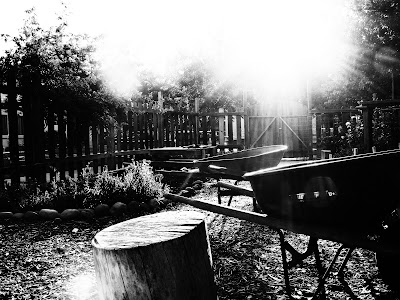
What has diffused the construction discomfort is the support of the community of families and friends. Over the weekend, work crews of volunteer parents, Board members, faculty, and staff worked hard with gloves, rakes, shovels, wheelbarrows, hammers, and assorted power tools to bring the school closer to being ready for Opening Day.

Gloved hands with strong will forces.

The curriculum of the sixth grade is about transformation and the laws of cause and effect, the art is about light and shadows, the inner work is about fortitude and moral resolve. I took the following images this Sunday morning, when the campus was quiet and still. The process of transformation was evident in the materials laying about the campus, the black and white imagery reflected the dance of light and shadow, and I felt the powerful textures of earthmovers and scaffolding, of boards and rubble somehow told a story of hope and resolve.

The campus and the children are growing together.


Saturday, August 28, 2010

mindful and artful

the teaching and learning setting


I will be greeting my sixth grade students at Davis Waldorf School in less than two weeks! With a handshake and a good morning, I will welcome them into the classroom space. It is the space where teaching and learning will meet; it must hold us and support us. With a feng shui background, it was with mindfulness and intention that I designed the sixth grade classroom. The classroom is minimalist and uncluttered. There are living plants that the children will nurture and make grow. There are some decorative objects that are born from nature and crafted by hand. Musical instruments and artwork inspire creativity. Rugs, lamps, and pillows give lightness and warmth. Placement of students' desks and my desk, bookshelves, and file cabinets organize work spaces. I am fortunate to have a large enough room to define a space for my work, where I feel supported and protected. When I am prepping for school, the children are all home, the campus is quiet, and the room is all mine, I can pause and sit at the piano and play. It is my meditation; I breathe, and I will look forward to another day.

Friday, August 20, 2010

west davis pond

a nature walk at the end of the street


A protected wetlands, the West Davis Pond, sits just a few steps away from our home. Designed to offer stormwater space, the West Davis Pond also provides a home for wildlife such as egrets and Canadian geese. We walked to the end of our street and entered into the paths that circled the Pond. Living in Davis is full of simple pleasures that allow family to spend time together in a safe, friendly environment.

Sunday, August 15, 2010

you will know

a verse of feeling and knowing


when you feel the soul of the cosmos

then you will know peace


when you feel the soul of the earth

then you will know harmony


when you feel the soul of the family

then you will know love


when you feel the soul of the self

then you will know


Sunday, August 8, 2010

know thyself

learning to be, and to be a teacher


With a five-week summer training program at Rudolf Steiner College completed, I am taking this Sunday morning to breathe, to fill a request for over easy eggs from my youngest son, and well, of course, to reflect-blog!

I began my teacher training last year, and this summer was the second in a four-year summer program; my cup is half full. Oddly, it feels both too much and not enough.

(Break for making breakfast.)

Steiner's work in anthroposophy and Waldorf education is monumental. His philosophical ideas and ideals are imbued with science and spirituality that reach out to the cosmos. His advice and teachings have an interdisciplinary range that is vast. His work is informed by multicultural forces of past, present, and future. In our training this summer, we are in our average day giving quality to the consciousness soul, then telling a story about giants, fairies, and queens and how to present with reverence the pentatonic flute to a first grader, then doing a tinikling dance with bamboo, then singing in three part harmony in Hebrew, then doing free-hand geometry, then trying to delineate the four temperaments,then proving the Pythagorean theorem, then reciting Shakespearean sonnets, and finally, in a refreshing and joyful out of character experience with Antje Staub, ending the day with a rap song about antipathy and sympathy!

And this is why processing is so important. The students of the program, teachers in training, have received a generous heap of salad greens to digest, beautifully prepared and presented by our caring intructors. We ate up our plates, wishing for more time to enjoy it. But aside from the lingering flavors on our taste buds, all the goodness of the meal is inside us. We must now allow ourselves to process, to metabolize, to let the nutritive forces of the training to find their way into our muscles and nerves.

In so doing, in entering into the digestive phase, we can hear the quiet murmuring of our bodies, and if you really listen, there is one truth, one maxim, one directive: KNOW ONESELF. In ancient Greek, this aphorism was inscribed on the Temple of Apollo at Delphi. It has been the slogan of the enlightened for over 4000 years, most likely even further back when early humans, without speech or the written word, just knew.

Floating in the ether of too much and not enough, it is best to land on the ground of the SELF. One classmate, Hillary, in a moment of clarity we all shared, said, "I am enough." But the feeling of not being prepared, which we also all shared, especially for those of us about to dive into teaching this Fall, makes one doubt oneself. It is not easy to hold back the tides of insecurity, which can rise and engulf the ground of the self. It is not enough to be barely holding one's head above the water. So how do we have the feeling of being enough?

One must find calmness in simply being. To just be. To be in the realm of ONENESS, the core of the SELF. (The SELF is one of the five spheres of Waldorf education.)

Connecting with the inner self, and being so fully at peace with what is there, I believe will give us the freedom to be fully present and fully in the moment with the children. This is what I love about the Waldorf way: my being, which holds the power of the cosmos, is blessed to teach the children. Not to teach the curriculum, or to be tethered to some prescriptive standard. But to be the author and artist, expressions of the self, to be a teacher. On a practical note, choose what works for you. Gather your bag of curriculum concepts, your bag of Waldorf goodies, then create from the self. On an esoteric note, meditate. According to Chelsey, a friend and classmate, "Inner work is our battle cry!"

Whether you will be in a Waldorf classroom, a homeschooling parent, or are in a quest for inner enlightenment, it all begins with the self.

It all begins now.

(Break for finishing my cup of coffee.)

It all begins now.

(Break for unpacking boxes from moving to our new place in Davis!)

It all begins now!

Sunday, August 1, 2010

singing with eva

developing our vocal instruments


Melody finds the deepest places within our bodies and pulls us to float on each note. Harmony weaves the threads that wrap us in color, warmth, and love. Lyrics resound like a warrior god or whisper like a dreamy lover.

But a choir of voices, oh how truly the song of many hearts enraptures the soul!

Morning singing with Eva Cranstoun, enhanced by the acoustics of Stegmann Hall, begins a wondrous, romantic day at Rudolf Steiner College. We enter the room with hardwood floors and plastered walls, and find chairs neatly positioned in a gentle arch with a piano and Eva at the center. Quiet good mornings and hellos and how are yous are exchanged, and with a faint yet purposeful chord from the piano, Eva captures our attention. She smiles, and before even a sound is uttered from her lips, she already appears to be singing. I believe her angels just hover around her, and they are most likely humming perpetually.

A room full of striving individuals, Waldorf teachers, with varying levels of singing experience, most with a mild dose of singing confidence. Eva is smiling because she senses, she knows, that each of us are carrying an instrument that can produce sound, beautiful, rich sound. Like all fine instruments, it needs to be prepared and developed. And the musician, with his or her own vocal instrument, must understand the rudimentary skills to use it well.

Posture is a key element to prepare us for singing. Eva directs us to slouch with half-present eyes, then to shift to an upright sitting position with alertness in our eyes and a smile. It is an effective technique, for the difference in mood and feeling of readiness is apparent – with the proper posture and mindset, we look ready, we feel ready.

We do not sit with stiffness in our bones, or tenseness in our shoulders. We move with gentle rolling motions; we loosen our necks. When we are to sing, we must be aware of the muscles in our bodies and remain supple, yet firm. We must be aware of our breathing, and the muscle of singing, the diaphragm. Air can then travel with ease in and out of our airways to feed the vocal cords.

Eva looks at us and when she sees that we are ready to practice our instruments, she gives brief instructions. She demonstrates how we are to hold our lips, our tongues, cheeks, jaws, and teeth to form the sounds. She sings a few notes. With just warm up scales, she sounds absolutely divine! Where is that voice coming from, penetrating through us, vibrating in our bones and our minds? It comes from Eva’s instrument, no doubt cared for and practiced with reverence. She models how we are to treat our instruments. We sing, and outwardly, it does not sound bad at all. Inwardly, confidence is building.

She gives us a few sheets of music. Shalom Aleichem is one of the songs and clearly, Eva has the confidence that we are capable of singing in three part harmony. She sings each part, she plays each part. We imitate and sing. First, get the melody, she says. In Hebrew, the words are meaningless to us (unless you can read Hebrew), but no matter, it makes us focus on the melody, on the quality of the sound. Now, get the words. Listen to each other; always listen for each other’s voices.

With our vocal development flowing nicely in a week’s worth of Eva’s insights and modeling, we sing a new song, Where is the Moon. Eva mentions that it is a wonderful song to sing for the sixth graders. As a teacher for the sixth grade next year, I am lucky to have a few songs that we practiced for that grade level. I pose a question to her: If I cannot reach the high notes of that song, how am I to teach it to the sixth graders?

Eva addresses my concern. I can certainly play the piano to teach the children the melody and the right pitches. However, as is the way of Waldorf, we teach how to be striving, living, loving individuals. You must sing, Eva says with conviction. And I agree with her, I must show courage in the act of singing, this is key to my vocal development. My class must see that I am not afraid, that I am willing to try, for that is the golden lesson after all. And what better way to learn a lesson than through song.

Eva teaches the class about vocal development, but I am a romantic, so I believe she is really teaching us about love. Our development as a whole human being depends on embracing each aspect of our bodies and abilities. The vocal cords as our instruments deserve to be cultivated. In their cultivation can we share the love in our hearts. Then, as Mozart joyfully sings out, we can live a truly long life with romance and song!