Friday, September 10, 2010

opening day

reverence and the rose


Davis Waldorf School celebrated its first day of school with the Rose Ceremony. It symbolizes the beliefs of the Waldorf way: honoring the beauty of the spiritual nature of the child. With reverence and grace, each grades teacher proudly expressed the voyage of their students through the curriculum and through the developmental stage of that particular grade.

As the sixth grade teacher for Davis Waldorf, I spoke of the new sense of reasoning awakening in the 12 year old child, which opens their hearts to the transformation of people and places in their curriculum. More importantly, the course of the year will see a transformation in the children themselves.

offering a hand-made gift for my colleague, Coleen Borrego

The opening day celebration centers around the Rose Ceremony. Ms. Ute Luebeck, our dear first grade teacher, shared heart-felt words with the parents. Truly, the first grade child will begin on a path of wonder and adventure, but they need not fear. With gentleness, our eighth grade children, young adults, offer the rose to the little ones as a token of friendship, peace, calm, and beauty. Then the parents had formed an arc of sunflowers that lead the way for Ms. Luebeck and the children to enter into the first grade classroom.

It is a magical way for the little ones to begin the school year.

my son Wilson gets a hug, a crown, a key, and an 8th grade buddy


Angela Kost, our strings teacher, provides music for the ceremony


a beautiful and welcoming display

a new gate for the lower grades garden

warm, calm, nurturing kindergarten spaces

It was also a magical way to begin my first year with the sixth grade! With consciousness of the incredible task about to unfold, I prepared as best as I could for this day, for my year. I moved my family to Davis over the summer, a huge task in itself. I spent 5 intense weeks at Steiner College. I wrote a variety of material to organize my thoughts and plans for the year, created a Google Group for my parents, cleaned and organized my classroom, planned our sixth grade Mount Lassen filed trip, gathered resources, painted and sanded my gift for the fifth grade teacher the night before opening day, and it continues.

This first day was key, it sets the tone for the year. Jennifer knitted me a tie to wear for Opening Day, which I was glad for. In so many ways, it was an important day. It was the first day of school for my three kids at Davis Waldorf, it was my first day to greet the community, it was my first day to be in the classroom with the sixth graders.

And as I write this blog at the end of this first week, I will say that I am truly grateful for them. They have shown me this week that they have the courage, honor, faith, and heart to take this journey with me. And as I reflect on the first day of school with the children, I feel that a connection was made, and the natural bond formed felt as if I had been standing in front of the classroom with them much longer.

Sunday, August 29, 2010

growing pains

campus under construction


Like the twelve year old child, the campus is undergoing some major changes! Just as my sixth grade students are entering into a new phase of life, so too is Davis Waldorf School.

Growing in spirit over two and a half decades, Davis Waldorf has built a reputation in the community for the loving embrace that held the children and their families. Now, the school also grows in classroom and office spaces. As new prefab buildings totaling over 4000 square feet are secured to poured concrete foundations, trenches with new utility lines and plumbing are excavated and filled, play strucutres uprooted and replanted, irrigation and drainage lines revamped, lawns and flower beds disturbed and replaced, Davis Waldorf is experiencing some growing pains.

What has diffused the construction discomfort is the support of the community of families and friends. Over the weekend, work crews of volunteer parents, Board members, faculty, and staff worked hard with gloves, rakes, shovels, wheelbarrows, hammers, and assorted power tools to bring the school closer to being ready for Opening Day.

Gloved hands with strong will forces.

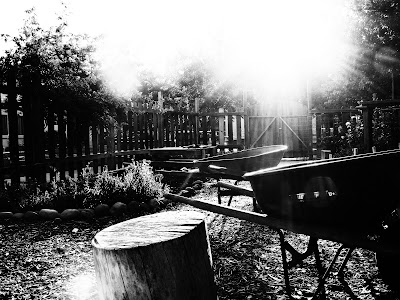
The curriculum of the sixth grade is about transformation and the laws of cause and effect, the art is about light and shadows, the inner work is about fortitude and moral resolve. I took the following images this Sunday morning, when the campus was quiet and still. The process of transformation was evident in the materials laying about the campus, the black and white imagery reflected the dance of light and shadow, and I felt the powerful textures of earthmovers and scaffolding, of boards and rubble somehow told a story of hope and resolve.

The campus and the children are growing together.


Saturday, August 28, 2010

mindful and artful

the teaching and learning setting


I will be greeting my sixth grade students at Davis Waldorf School in less than two weeks! With a handshake and a good morning, I will welcome them into the classroom space. It is the space where teaching and learning will meet; it must hold us and support us. With a feng shui background, it was with mindfulness and intention that I designed the sixth grade classroom. The classroom is minimalist and uncluttered. There are living plants that the children will nurture and make grow. There are some decorative objects that are born from nature and crafted by hand. Musical instruments and artwork inspire creativity. Rugs, lamps, and pillows give lightness and warmth. Placement of students' desks and my desk, bookshelves, and file cabinets organize work spaces. I am fortunate to have a large enough room to define a space for my work, where I feel supported and protected. When I am prepping for school, the children are all home, the campus is quiet, and the room is all mine, I can pause and sit at the piano and play. It is my meditation; I breathe, and I will look forward to another day.

Friday, August 20, 2010

west davis pond

a nature walk at the end of the street


A protected wetlands, the West Davis Pond, sits just a few steps away from our home. Designed to offer stormwater space, the West Davis Pond also provides a home for wildlife such as egrets and Canadian geese. We walked to the end of our street and entered into the paths that circled the Pond. Living in Davis is full of simple pleasures that allow family to spend time together in a safe, friendly environment.

Sunday, August 15, 2010

you will know

a verse of feeling and knowing


when you feel the soul of the cosmos

then you will know peace


when you feel the soul of the earth

then you will know harmony


when you feel the soul of the family

then you will know love


when you feel the soul of the self

then you will know


Sunday, August 8, 2010

know thyself

learning to be, and to be a teacher


With a five-week summer training program at Rudolf Steiner College completed, I am taking this Sunday morning to breathe, to fill a request for over easy eggs from my youngest son, and well, of course, to reflect-blog!

I began my teacher training last year, and this summer was the second in a four-year summer program; my cup is half full. Oddly, it feels both too much and not enough.

(Break for making breakfast.)

Steiner's work in anthroposophy and Waldorf education is monumental. His philosophical ideas and ideals are imbued with science and spirituality that reach out to the cosmos. His advice and teachings have an interdisciplinary range that is vast. His work is informed by multicultural forces of past, present, and future. In our training this summer, we are in our average day giving quality to the consciousness soul, then telling a story about giants, fairies, and queens and how to present with reverence the pentatonic flute to a first grader, then doing a tinikling dance with bamboo, then singing in three part harmony in Hebrew, then doing free-hand geometry, then trying to delineate the four temperaments,then proving the Pythagorean theorem, then reciting Shakespearean sonnets, and finally, in a refreshing and joyful out of character experience with Antje Staub, ending the day with a rap song about antipathy and sympathy!

And this is why processing is so important. The students of the program, teachers in training, have received a generous heap of salad greens to digest, beautifully prepared and presented by our caring intructors. We ate up our plates, wishing for more time to enjoy it. But aside from the lingering flavors on our taste buds, all the goodness of the meal is inside us. We must now allow ourselves to process, to metabolize, to let the nutritive forces of the training to find their way into our muscles and nerves.

In so doing, in entering into the digestive phase, we can hear the quiet murmuring of our bodies, and if you really listen, there is one truth, one maxim, one directive: KNOW ONESELF. In ancient Greek, this aphorism was inscribed on the Temple of Apollo at Delphi. It has been the slogan of the enlightened for over 4000 years, most likely even further back when early humans, without speech or the written word, just knew.

Floating in the ether of too much and not enough, it is best to land on the ground of the SELF. One classmate, Hillary, in a moment of clarity we all shared, said, "I am enough." But the feeling of not being prepared, which we also all shared, especially for those of us about to dive into teaching this Fall, makes one doubt oneself. It is not easy to hold back the tides of insecurity, which can rise and engulf the ground of the self. It is not enough to be barely holding one's head above the water. So how do we have the feeling of being enough?

One must find calmness in simply being. To just be. To be in the realm of ONENESS, the core of the SELF. (The SELF is one of the five spheres of Waldorf education.)

Connecting with the inner self, and being so fully at peace with what is there, I believe will give us the freedom to be fully present and fully in the moment with the children. This is what I love about the Waldorf way: my being, which holds the power of the cosmos, is blessed to teach the children. Not to teach the curriculum, or to be tethered to some prescriptive standard. But to be the author and artist, expressions of the self, to be a teacher. On a practical note, choose what works for you. Gather your bag of curriculum concepts, your bag of Waldorf goodies, then create from the self. On an esoteric note, meditate. According to Chelsey, a friend and classmate, "Inner work is our battle cry!"

Whether you will be in a Waldorf classroom, a homeschooling parent, or are in a quest for inner enlightenment, it all begins with the self.

It all begins now.

(Break for finishing my cup of coffee.)

It all begins now.

(Break for unpacking boxes from moving to our new place in Davis!)

It all begins now!

Sunday, August 1, 2010

singing with eva

developing our vocal instruments


Melody finds the deepest places within our bodies and pulls us to float on each note. Harmony weaves the threads that wrap us in color, warmth, and love. Lyrics resound like a warrior god or whisper like a dreamy lover.

But a choir of voices, oh how truly the song of many hearts enraptures the soul!

Morning singing with Eva Cranstoun, enhanced by the acoustics of Stegmann Hall, begins a wondrous, romantic day at Rudolf Steiner College. We enter the room with hardwood floors and plastered walls, and find chairs neatly positioned in a gentle arch with a piano and Eva at the center. Quiet good mornings and hellos and how are yous are exchanged, and with a faint yet purposeful chord from the piano, Eva captures our attention. She smiles, and before even a sound is uttered from her lips, she already appears to be singing. I believe her angels just hover around her, and they are most likely humming perpetually.

A room full of striving individuals, Waldorf teachers, with varying levels of singing experience, most with a mild dose of singing confidence. Eva is smiling because she senses, she knows, that each of us are carrying an instrument that can produce sound, beautiful, rich sound. Like all fine instruments, it needs to be prepared and developed. And the musician, with his or her own vocal instrument, must understand the rudimentary skills to use it well.

Posture is a key element to prepare us for singing. Eva directs us to slouch with half-present eyes, then to shift to an upright sitting position with alertness in our eyes and a smile. It is an effective technique, for the difference in mood and feeling of readiness is apparent – with the proper posture and mindset, we look ready, we feel ready.

We do not sit with stiffness in our bones, or tenseness in our shoulders. We move with gentle rolling motions; we loosen our necks. When we are to sing, we must be aware of the muscles in our bodies and remain supple, yet firm. We must be aware of our breathing, and the muscle of singing, the diaphragm. Air can then travel with ease in and out of our airways to feed the vocal cords.

Eva looks at us and when she sees that we are ready to practice our instruments, she gives brief instructions. She demonstrates how we are to hold our lips, our tongues, cheeks, jaws, and teeth to form the sounds. She sings a few notes. With just warm up scales, she sounds absolutely divine! Where is that voice coming from, penetrating through us, vibrating in our bones and our minds? It comes from Eva’s instrument, no doubt cared for and practiced with reverence. She models how we are to treat our instruments. We sing, and outwardly, it does not sound bad at all. Inwardly, confidence is building.

She gives us a few sheets of music. Shalom Aleichem is one of the songs and clearly, Eva has the confidence that we are capable of singing in three part harmony. She sings each part, she plays each part. We imitate and sing. First, get the melody, she says. In Hebrew, the words are meaningless to us (unless you can read Hebrew), but no matter, it makes us focus on the melody, on the quality of the sound. Now, get the words. Listen to each other; always listen for each other’s voices.

With our vocal development flowing nicely in a week’s worth of Eva’s insights and modeling, we sing a new song, Where is the Moon. Eva mentions that it is a wonderful song to sing for the sixth graders. As a teacher for the sixth grade next year, I am lucky to have a few songs that we practiced for that grade level. I pose a question to her: If I cannot reach the high notes of that song, how am I to teach it to the sixth graders?

Eva addresses my concern. I can certainly play the piano to teach the children the melody and the right pitches. However, as is the way of Waldorf, we teach how to be striving, living, loving individuals. You must sing, Eva says with conviction. And I agree with her, I must show courage in the act of singing, this is key to my vocal development. My class must see that I am not afraid, that I am willing to try, for that is the golden lesson after all. And what better way to learn a lesson than through song.

Eva teaches the class about vocal development, but I am a romantic, so I believe she is really teaching us about love. Our development as a whole human being depends on embracing each aspect of our bodies and abilities. The vocal cords as our instruments deserve to be cultivated. In their cultivation can we share the love in our hearts. Then, as Mozart joyfully sings out, we can live a truly long life with romance and song!

Friday, July 23, 2010

phenomenology

and modern science


I wrote an essay for my phenomenology class at Steiner College. In short, phenomenology is an approach to science that studies the world through what we as humans can directly observe and experience. For instance, in studying nature, we must examine the plant as a whole, and in the parts we can see with our naked eyes. In so doing, we learn the true essence of the nature of the plant. In my essay, "Inward Spiral, Outward Spiral," I support the reductivist methodology of modern science while also encouraging the phenomenological approach. I think the combination of both gives us the little pictures and the big picture of our natural world.

Here is the essay. Enjoy!


In college, I took many classes for my biological sciences major that ended in –ology, such as biology, microbiology, bacteriology, anthropology, and zoology. In medical school, I had classes such as pharmacology and physiology. Clearly, we humans love to study things! These disciplines represent only a fraction of the sciences that exist out there today. And it seems new fields of science are developing each day. Combined with the other areas of human life such as sociology, geography, history, economics, mathematics, physics, computer sciences, language arts, music, arts, and crafts, it becomes evident that we really like to study things, to try and make sense of things, to try and figure out what life is all about, and to perhaps connect our lives with the larger cosmos.

Another field of study is phenomenology. Johann Wolfgang von Goethe followed the principles of phenomenology in his approach to studying nature. In studying nature through the lens of this discipline, he believes that we can find a connection to the cosmos and to the understanding of things. In the direct human experience of nature, through the “encountering” of nature with what physical senses we are endowed with and what inner intellect we have, the true essence of the object would reveal itself to us. He states, “Each phenomenon in nature, rightly observed, wakens in us a new organ of understanding.”

In studying nature, we need to cultivate the ability to let thoughts dissolve and experience, for instance, the plant kingdom as just the thing-in-itself. We need to be active in not doing, and allow the plant to speak. It would tell us all the mysteries of its life, and ultimately, the truths of existence. It is an elegant and beautiful view of the study of nature.

In the Waldorf classroom, in particular, the grades, where the teacher is appealing to the feeling life of the students, this phenomenological approach serves the teacher well in enlivening the curriculum. The child, whether as a first grader simply strolling through a wooded path or a seventh grader actively contemplating the phyllotaxy of Rosmarinus officinalis, the direct experience of the phenomena of nature is satisfying and life-affirming. It aids the teacher in fostering a love of learning that we all want for our children.

The interactive, phenomenological approach connects us to the elements, the tangible stuff that our world is made of and within which we experience the world in a very intimate way. Air, water, fire, and earth. Inspiration, imagination, intuition, and intellect. In the material elements are the human elements. For an eighth grade physics block, I was cognizant of actively approaching my lessons through a phenomenological lens. We studied the properties of heat by directly observing and experiencing the effects of fire, and the sun on our skin, on our clothing, on different materials, in a room. We studied magnetism, pressure, and even some physiology. But I come from a “traditional” science background, and I would say that my lessons were not purely phenomenological. While I did not formally engage the students in the scientific method, I still felt it important to include concepts such as refraction and reflection, convection and radiation, rays of incidence, etc., all products of the reductivist, 20th century approach to the sciences.

And this brings me to the title of this essay, “Inward Spiral, Outward Spiral.” There is validity in the phenomenological approach, and certainly, if our walk through the bio-dynamic garden, and our using our senses to learn about yarrow, agapanthus, sunflowers, and apples demonstrate this method, then it is a welcome approach – definitely more joyful than leaning over a microscope in a lab to look at a cross-section of xylem and phloem! But I feel a sense of obligation to defend the work of the great scientists of our time, who took the reductivist path to exploring and understanding the sciences. I believe that humans are young, relative to the history of the cosmos. It has been only about 10,000 years ago that human history had begun to be recorded, only about 1000 years ago that the scientific method was born, only about 100 years ago that human genetics was being studied, and only 10 years ago that the human genome was mapped.

The work of a multitude of really smart people, of so many minds working towards the betterment of humankind, lead to the advancements in the field of genetics and medical science. These advancements arose from reductivist science, not phenomenological science. In the eyes of Goethe, all the research going on in these medical laboratories are a “calamity,” that the “use of experiments has severed nature from man…microscopes and telescopes, in actual fact, confuse man’s innate clarity of mind.” But, I believe we need to give modern science a chance. Modern science is in a period of what I call the Inward Spiral.

Imagine the snail shell, and beginning at the outermost contour of the shell, one can trace a path that gradually spirals into a point more or less in the middle of the shell. Now imagine that a tiny human can walk along the contour of this shell. As the human is walking, he is seeing the world, and he is taking in the wonder of it all. At first, he is accepting, for example, the mysteries of the weather or his body as divine. As he walks the Inward Spiral, he develops questions that dig deeper and deeper, he makes observations, he creates experiments, he gathers data, he makes calculations, he creates more elaborate experiments, his measurements become more precise, he aids his senses with tools to gain new perspectives, his quest leads him to examine the parts of the whole, then the parts of the parts, then the parts of the parts of the parts. He goes from body, to cell, to nucleus, to chromosomes, to DNA sequences, to base pairs, to molecules, to elements, to atoms, to subatomic particles, to maybe even the “God” particle. This is the path of modern science, of the Inward Spiral.

We are at a moment in human history where we are walking the contour of the snail shell towards the middle of the spiral. What happens when we reach the endpoint?
We enter then into a new phase of human history, the Outward Spiral. Here, I think we as humans will have developed a deep understanding of the materiality and elementality of our existence that our course will then change. In using the intellectuality we were born with to gain the knowledge amassed during the Inward Spiral, we can walk with spirituality, with deep global citizenry, and with a holistic view. This is the Outward Spiral.

I think perhaps that we humans need to enter into the Inward Spiral to be able to actively, and rightly engage ourselves in the Outward Spiral. We are young, and we are still in the process of awakening our senses and our spirits. In the Outward Spiral, as I think some of our scientists have entered into, they are finding ways of healing our earth, curing diseases, and discovering the connectedness of the kingdoms. At the outermost contour of the Outward Spiral, we will discover the spirituality that will bring peace to all the world’s creatures and the universe.

Maybe the advocates of phenomenology have old souls that can already see with enlightened eyes. They may not need to enter into the Inward Spiral to experience the Outward Spiral to reach the cosmos.

David Seamon states in Goethe's Way of Science: A Phenomenology of Nature, “We must somehow find ways to bring our thoughts, feelings, and actions in harmony both with ourselves and with the world in which we live.”

I invite him to take a stroll along the Inward Spiral with me. We might spend some time in a research facility splitting an atom, but that stroll will also have time spent smelling the fragrant aroma of roses or jasmine, feeling the warmth of the sun, tasting the sweetness of a persimmon, and listening to the flow of a stream – the phenomena of our immensely amazing world.

Saturday, July 17, 2010

teacher training

summer school at steiner college


This summer, I am back at Rudolf Steiner College in Fair Oaks for my teacher training program. As I look forward to my post as the sixth grade teacher for Davis Waldorf in the Fall, I am excited to receive new insights and pedagogy from my instructors at the College. Thus far, in this past two weeks, the classes I have had are: eurythmy, singing, child observation, speech, painting, inner work, cosmology, and phenomenology.

The Waldorf teacher strives for the balance of head, heart, and hands for his or her students indeed, but this balance begins within the teacher. The training attempts to provide the teacher with a wealth of practical and intellectual knowledge that would enrich the teaching life.

This balance actually begins even before the formal teacher training is received. No one can teach another individual how to be compassionate, how to share one's life work, how to be giving, how to be selfless, how to be of service to humankind. These have to come from somewhere within the person. One's inner life then informs the outer engagement of life, and the harmony of spirit, mind, and the will gives the teacher the true foundation to be an excellent teacher.

The training, any teacher training, only gives information. How one uses the information, how one makes it his own, how one converts that information to a beautiful teaching experience is up to the teacher.

The children of a teacher who enters the classroom with compassion in his heart, artistry in his hands, and nimbleness of his mind are blessed. I strive to be this teacher.


Monday, June 28, 2010

crafting creativity

summer craft conference at steiner college


Jennifer has a boundless creative spirit. Her fiber crafting has thoroughly blossomed. The seeds of fiber delight were planted by her mother and grandmother through the passing on of knitting and crocheting. In college, I remember the amazing crocheted quilts she produced. Then, gradually, quietly, miles and miles of yarn crept into our home like tendrils of a magical vine, filling every cabinet space, and it was total yarnage! Then, perhaps, along with the growth of our children, Jennifer branched out to carding and spinning her own fibers and yarns. Adorable, unique, delicate, quirky fiber creations sprouted like wildflowers. Tunisian crocheting, kumihimo, weaving, needle felting, hand-dyeing, Jennifer harvested a crop of creative wonders.

A summer handcrafts conference with Ruskin Mills at Steiner College this week is another beautiful element to add to Jennifer's fiber garden. The conference is called Recreating the Human Vessel: Educating through Rhythm and Crafts.

This is the way of Jennifer's creative soul. She loves to learn for herself, but I think she loves to learn equally to be able to share it with others. All her creative energy often becomes the nourishing water and light for our kids, and others around the world, coaxing the expression of artistry in others take root.

Friday, June 25, 2010

watercoloring video

from earthschooling


We had the pleasure of hosting Dr. Kristie Burns one weekend when she was a workshop speaker at a conference at nearby Rudolf Steiner College. Kristie has a wonderful website called The Bearth Institute, where she has many reosurces to help families in their homeschooling journeys. With video camera always ready to capture a lesson opportunity, Kristie convinced me to do a video workshop on wet-on-wet method painting. You can take a peek at Part One of my Watercolor Journey debut video.
Thanks, Kristie, for your energy in sharing our creative lives!


Sunday, June 20, 2010

father's day

a family day


In the morning, my family treated me to a breakfast of funnel cakes and gifts made by their loving hands. For lunch, we invited my mom and dad, my brothers, and their families. I have four younger brothers, two of whom are married with children. My kids have four cousins on the Tan side of the family. To find everyone in good spirits, to share a meal prepared by all, to enjoy a sunny Sunday afternoon together, this father's heart fills with peace. Father's Day, when everyone gathers, is really Family Day!


my mom and dad with the grandkids


the "original" Tans


Jennifer


a shady spot for lunch


Friday, June 18, 2010

teleseminar grades one thru three

The Waldorf Connection Homeschool Expo workshops


Rick is speaking on Saturday, June 19 at 4:30pm EST on Grade Overview 1st-3rd. You can access this on your phone or online. If you are on your computer, you will also be able to see a visual presentation.

Length: approx. 60-70 minutes. Replays are available for 48 hours after live call for free. You may also purchase mp3 files. You must register in advance. Free registration: http://thewaldorfconnection.com/dap/a/?a=8

Tuesday, June 15, 2010

fabulous forty

a birthday verse for my wife


At ten,
You were someone I did not know,
A girl, dancing, playing with her Barbies,
And I was entering my teen world.

At twenty,
My girlfriend whom I was glad to know,
A young woman, learning at UC Davis,
And I was studying too in our college town.

At thirty,
My wife whom I had grown to know,
A mother and principal at Rail Ranch Elementary.
And I was caring for kids and a lawn to mow.

At forty,
My partner whom there is much yet to know,
A being of immense Love and boundless Energy,
And the children and I love you more and more.